
Kurt Cobain was found dead in his Seattle home on April 8, 1994. He was 27 years old. The note he left behind was written in red pen, addressed to his childhood imaginary friend “Boddah,” and has been studied, debated, and disputed ever since. Before getting to the note itself, the story of how Cobain got to that room matters just as much.
A Childhood That Left Marks
Kurt Donald Cobain was born on February 20, 1967, in Aberdeen, Washington — a small, economically struggling logging town on the coast. His early years were stable enough, but his parents’ marriage collapsed when he was eight years old. The divorce hit him harder than most children. Teachers and family members noted a visible change in his personality after it happened. He became withdrawn, angry, and difficult to reach.
He moved between relatives repeatedly. His father remarried. His mother struggled. Neither home felt permanent. Cobain later spoke openly about the divorce as the central wound of his childhood, and its effects showed up repeatedly in his lyrics — the isolation, the feeling of not belonging anywhere, the search for something steady in a world that kept shifting under him.
Aberdeen didn’t help. It was a town with limited opportunities and a deeply conservative culture that had little patience for a sensitive, artistically inclined kid who didn’t fit the expected mold. Cobain was bullied, socially isolated, and drawn toward music as the one place where his feelings made sense. He started playing guitar as a teenager and never stopped.
The Rise of Nirvana
Cobain formed Nirvana in Aberdeen in 1987 with bassist Krist Novoselic. The band went through several drummers before Dave Grohl joined in 1990. Their 1991 album Nevermind was released on a modest budget with modest expectations and proceeded to dismantle everything that was happening in mainstream rock at the time.
“Smells Like Teen Spirit” became a generational anthem almost immediately. The album sold 30 million copies worldwide. Nirvana went from playing small clubs to headlining arenas in under a year. Cobain, who had spent his entire life feeling like an outsider, suddenly found himself at the center of a cultural movement he hadn’t asked to lead.
The success broke something in him. Cobain was deeply uncomfortable with fame. He had written music as a personal outlet, as a way to process pain, and the moment it became a commercial product consumed by millions, he felt it had been taken from him. He said in interviews that he felt like a fraud standing on those stages. The bigger the crowds got, the worse he felt.
The Addiction
Cobain had been using heroin since the late 1980s, but his use escalated sharply as Nirvana’s fame grew. He later said the drug helped manage a chronic stomach condition that had caused him pain for years and that doctors had been unable to effectively treat. Whether that was the initial reason or a justification he leaned on, heroin became a daily fixture of his life by the early 1990s.
He and Courtney Love, whom he married in February 1992, were both using heavily during the period surrounding the birth of their daughter Frances Bean Cobain in August 1992. The tabloid coverage of their drug use during the pregnancy was brutal. Child services opened an investigation. The couple fought to retain custody of their daughter while both were in active addiction.
Cobain went through multiple attempts at getting clean. He entered and left treatment programs. He relapsed repeatedly. The addiction wasn’t just physical — it was tied to his anxiety, his stomach pain, his inability to cope with the pressure of being the spokesperson for a generation that kept projecting its own feelings onto him.
The Final Weeks
In March 1994, Cobain overdosed in Rome on a combination of champagne and the sedative Rohypnol. Courtney Love found him unconscious and he was hospitalized. The official statement called it an accident. People close to him understood it differently.
After returning to Seattle, his behavior became increasingly erratic and withdrawn. On March 30, 1994, his family and friends staged an intervention at their Lake Washington home. Cobain agreed to enter a detox program and flew to Los Angeles to check into the Exodus Recovery Center on April 1st.
He stayed two days. On April 2nd, he climbed over the facility’s wall and left. He flew back to Seattle. For the next several days, his whereabouts were unclear. Courtney Love hired private investigator Tom Grant to find him. Grant searched Seattle and Los Angeles without success.
On April 8, 1994, an electrician arriving at the Cobain home to do routine work discovered his body in the room above the garage. He had been dead for approximately three days.
The Note and the Debate
The suicide note was found at the scene, held in place by a pen stuck into a flower pot. It was written in red ink, four pages long, and addressed to Boddah — the name Cobain had given to an imaginary friend as a child.
The note’s main body reads like a farewell to music more than a farewell to life. Cobain writes about his inability to feel the excitement of performing that he once felt, his guilt over not being able to give his audience what they wanted, and his love for his daughter Frances. He quotes Neil Young’s lyric “it’s better to burn out than to fade away” — a line he had clearly been turning over in his mind for some time.
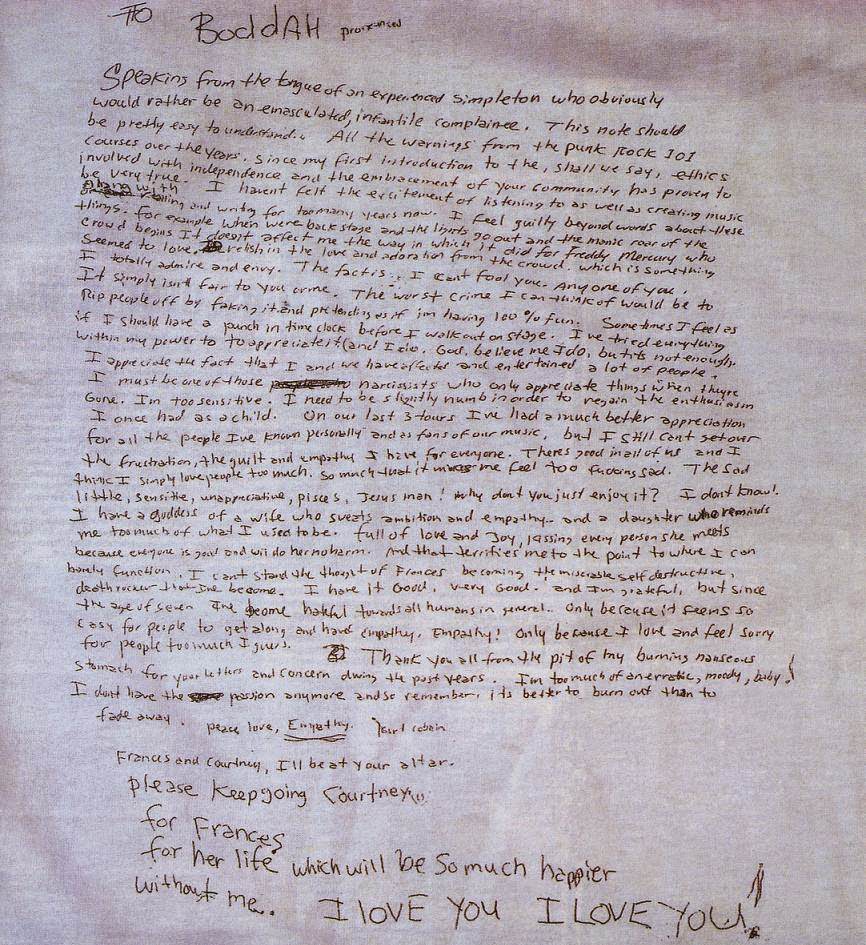
“To Boddah
Speaking from the tongue of an experienced simpleton who obviously would rather be an emasculated, infantile complain-ee. This note should be pretty easy to understand.
All the warnings from the punk rock 101 courses over the years, since my first introduction to the, shall we say, ethics involved with independence and the embracement of your community has proven to be very true. I haven’t felt the excitement of listening to as well as creating music along with reading and writing for too many years now. I feel guity beyond words about these things.
For example when we’re back stage and the lights go out and the manic roar of the crowds begins., it doesn’t affect me the way in which it did for Freddie Mercury, who seemed to love, relish in the the love and adoration from the crowd which is something I totally admire and envy. The fact is, I can’t fool you, any one of you. It simply isn’t fair to you or me. The worst crime I can think of would be to rip people off by faking it and pretending as if I’m having 100% fun. Sometimes I feel as if I should have a punch-in time clock before I walk out on stage. I’ve tried everything within my power to appreciate it (and I do,God, believe me I do, but it’s not enough). I appreciate the fact that I and we have affected and entertained a lot of people. It must be one of those narcissists who only appreciate things when they’re gone. I’m too sensitive. I need to be slightly numb in order to regain the enthusiasms I once had as a child.
On our last 3 tours, I’ve had a much better appreciation for all the people I’ve known personally, and as fans of our music, but I still can’t get over the frustration, the guilt and empathy I have for everyone. There’s good in all of us and I think I simply love people too much, so much that it makes me feel too fucking sad. The sad little, sensitive, unappreciative, Pisces, Jesus man. Why don’t you just enjoy it? I don’t know!
I have a goddess of a wife who sweats ambition and empathy and a daughter who reminds me too much of what i used to be, full of love and joy, kissing every person she meets because everyone is good and will do her no harm. And that terrifies me to the point to where I can barely function. I can’t stand the thought of Frances becoming the miserable, self-destructive, death rocker that I’ve become.
I have it good, very good, and I’m grateful, but since the age of seven, I’ve become hateful towards all humans in general. Only because it seems so easy for people to get along that have empathy. Only because I love and feel sorry for people too much I guess.
Thank you all from the pit of my burning, nauseous stomach for your letters and concern during the past years. I’m too much of an erratic, moody baby! I don’t have the passion anymore, and so remember, it’s better to burn out than to fade away.
Peace, love, empathy, Kurt Cobain.Frances and Courtney, I’ll be at your altar.
Please keep going Courtney
for Frances
for her life which will be so much happier without me.
I LOVE YOU. I LOVE YOU!”
Tom Grant, the private investigator hired by Courtney Love, later made copies of the note using Love’s fax machine and went public with a theory that the note’s main body was actually a letter announcing Cobain’s intention to leave the music business and his marriage — not to end his life. Grant argued that only the final few lines, written separately at the bottom of the page and in a slightly different style, actually referenced suicide, and that those lines were added by someone else.
Forensic document examiners hired to assess the note confirmed that the entire document was written by Cobain. When Cobain’s personal journals were published in 2002, readers discovered that he frequently structured his written entries this way — main body of thought followed by a separate concluding section with a different emotional register. The format of the suicide note was consistent with how he wrote privately throughout his life.
The 27 Club
Cobain’s death at 27 added his name to a list that already included Jimi Hendrix, Janis Joplin, and Jim Morrison — all of whom died at the same age. The grouping is known as the 27 Club, and while the age is a coincidence rather than a pattern with a causal explanation, the cultural weight of that number became part of how Cobain’s death was processed publicly.
What those four musicians shared was not just an age but a version of the same story — extraordinary talent, massive public pressure, substance addiction, and an inability to find stable ground inside lives that had been completely consumed by their own fame. Cobain had written about feeling like he didn’t belong in the world since he was a teenager in Aberdeen. Fame didn’t resolve that feeling. It amplified it.